Not every customer interaction carries the same value.
Some prospects are casually exploring options. Others are actively comparing vendors. And then there are high-intent buyers, the customers who already know what they need and are looking for the fastest path to a decision.
For businesses, these are the conversations that matter most.
The challenge is that many Voice AI implementations are designed to handle volume rather than intent. They treat every caller the same way, regardless of where the customer is in the buying journey. As a result, businesses often miss opportunities to engage qualified prospects when they are most ready to take action.
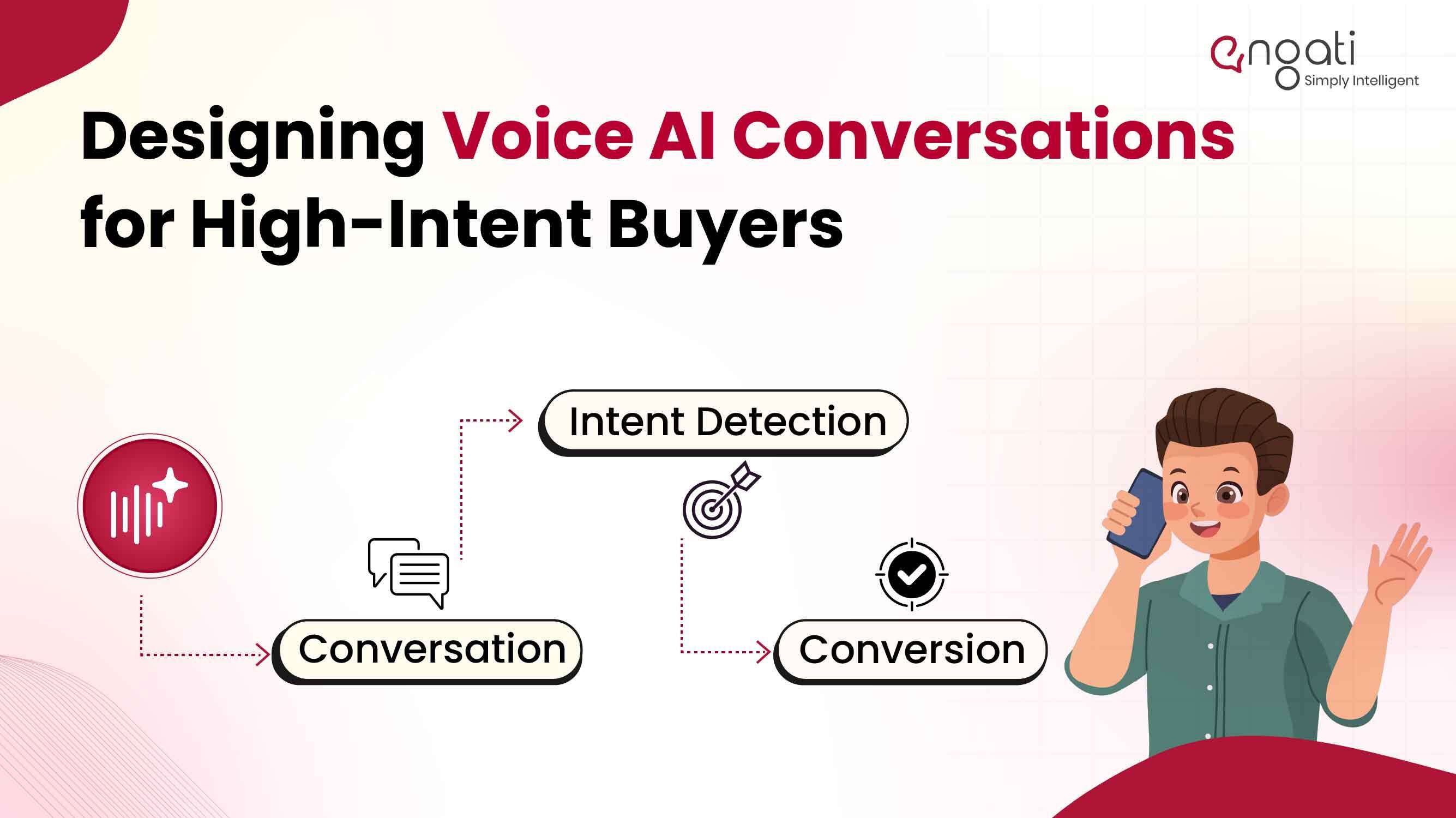
As Voice AI continues to become a key channel for customer engagement, organizations must rethink how conversations are designed. The goal is no longer just to automate interactions. It is to identify buying intent, accelerate decision-making, and create experiences that move prospects closer to conversion.
The most effective Voice AI strategies are built around conversational voice design, a framework that focuses on how conversations are structured, personalized, and optimized for customer outcomes.
Understanding High-Intent Buyers
Before designing conversations, businesses need to understand what makes a buyer high-intent.
High-intent buyers are individuals who have already demonstrated strong interest in a product or service through actions such as:
- Requesting a demo
- Filling out a lead form
- Clicking on pricing information
- Downloading product resources
- Comparing vendors
- Asking specific product-related questions
Unlike early-stage prospects, high-intent buyers are not looking for broad education. They are looking for clarity, confidence, and answers that help them make a decision.
This changes how Voice AI conversations should be structured. A customer who asks, "Can I schedule a product demo?" should not be treated the same way as someone who asks, "What does your company do?" The conversation must adapt to intent.
Why Traditional Voice Workflows Fail High-Intent Buyers
Many businesses still design automated voice interactions using a linear approach.
The system follows a fixed script:
- Greeting
- Qualification questions
- Information gathering
- Escalation or closure
While this approach may work for basic interactions, it often frustrates buyers who are already prepared to move forward.
Consider a prospect who recently visited a pricing page and requested a callback.
When they answer the phone, they may expect a conversation about implementation timelines, pricing options, or next steps.
Instead, they are asked:
- What is your name?
- Which product are you interested in?
- What company do you work for?
Information the business already possesses. This creates unnecessary friction and slows momentum. High-intent buyers value efficiency. Every unnecessary question increases the likelihood of disengagement.
The First 30 Seconds Determine the Outcome
The opening moments of a Voice AI conversation are critical.
High-intent buyers want immediate confirmation that the conversation is relevant.
A generic opening often signals that the interaction will waste their time.
For example:
"Hello. Thank you for taking this call. We would like to ask you a few questions."
This approach creates uncertainty.
A stronger alternative would be:
"Hi Sarah, thanks for requesting a demo of our customer engagement platform. I'm calling to understand your requirements and help schedule the right specialist."
This introduction instantly establishes:
- Context
- Purpose
- Relevance
- Value
The customer understands why the call is happening and what they can expect.
Effective conversational voice design removes uncertainty as early as possible.
Designing Conversations Around Buyer Intent
The most successful Voice AI systems are designed to recognize and respond to intent rather than simply follow scripts.
High-intent buyers often reveal their priorities through language.
For example:
- "How quickly can we implement this?"
- "What's included in the enterprise package?"
- "Can your platform integrate with Salesforce?"
- "How does pricing work?"
These are not support questions.
They are buying signals.
Voice AI should be capable of identifying these signals and adapting the conversation accordingly.
Intent-Based Conversation Design
Instead of forcing customers through a predetermined path, businesses should create flexible conversation flows that respond dynamically.
For example:
If a prospect asks about integrations, the AI can explore technical requirements.
If a prospect asks about pricing, the AI can qualify budget and buying timelines.
If a prospect asks about deployment, the AI can focus on implementation needs.
The conversation becomes more relevant because it aligns with the customer's goals.
This approach improves both customer experience and conversion potential.
Personalization Creates Momentum
High-intent buyers expect businesses to remember previous interactions.
If a prospect has downloaded a guide, attended a webinar, or requested a consultation, that context should inform the conversation.
Consider the difference between:
"How can I help you today?"
and
"I see you recently requested information about our AI Agent platform. Are you evaluating solutions for customer support, sales automation, or both?"
The second approach demonstrates awareness and reduces effort.
Personalization signals competence.
It reassures buyers that the business understands their needs and is prepared to provide relevant assistance.
Modern Voice AI systems can leverage CRM data, website activity, campaign interactions, and customer history to create more contextual conversations.
For high-intent buyers, this level of personalization often accelerates decision-making.
Using Voice AI to Identify Buying Signals
One of the most valuable capabilities of conversational AI is its ability to uncover signals that indicate purchase readiness.
These signals may include:
- Urgency
- Budget discussions
- Team involvement
- Vendor comparisons
- Implementation timelines
- Product-specific questions
For example, a prospect who says:
"We're planning to launch this quarter and need something operational within 30 days."
is demonstrating stronger intent than someone conducting preliminary research.
Voice AI can automatically identify these signals and score leads accordingly.
This allows sales teams to prioritize the most promising opportunities while reducing time spent on unqualified leads.
As AI automation becomes more sophisticated, intent detection will become one of the most important functions of Voice AI.
The Importance of Human Handoffs
Not every conversation should remain automated. In fact, one of the biggest mistakes businesses make is attempting to keep high-intent buyers inside automated workflows for too long. When prospects are ready to make a purchasing decision, speed matters. Delaying access to a human representative can create friction and slow conversion.
Designing Intelligent Escalation Paths
The best Voice AI experiences know when to transition the conversation.
Examples include:
- Requesting pricing discussions
- Asking for contract details
- Discussing enterprise requirements
- Requesting custom solutions
In these situations, Voice AI should seamlessly transfer the interaction to the appropriate sales representative while preserving conversation context. This creates a smooth buyer experience and prevents valuable opportunities from being lost. The future of conversational voice design is not AI versus humans. It is AI and humans working together to create better customer journeys.
Beyond Voice: Creating Omnichannel Buyer Journeys
Today's buyers rarely interact through a single channel.
A prospect may:
- Click a digital advertisement
- Browse product pages
- Speak with a Voice AI assistant
- Continue the conversation through WhatsApp
- Receive follow-up information via RCS
- Book a meeting with a sales representative
The most effective organizations connect these touchpoints into a unified journey.
Voice AI should not operate in isolation. When integrated with conversational AI platforms, CRM systems, WhatsApp automation, and RCS messaging, businesses can create seamless experiences that maintain context across every interaction. For high-intent buyers, continuity often becomes a competitive advantage.
The Future of Conversational Voice Design
As customer expectations evolve, conversational voice design will become a strategic discipline rather than a technical feature.
Organizations will increasingly focus on:
- Intent-driven conversations
- Real-time personalization
- Predictive engagement
- Buying signal detection
- Omnichannel orchestration
- AI-human collaboration
Businesses that master these capabilities will be better positioned to convert customer interest into revenue. The future of Voice AI is not about handling more conversations. It is about creating better conversations. High-intent buyers represent some of the most valuable opportunities for any business. Yet many organizations continue to treat these prospects the same way they treat every other customer interaction.
Designing Voice AI conversations around buyer intent changes that.
By prioritizing relevance, personalization, intent recognition, and intelligent escalation, businesses can create conversations that accelerate decision-making and improve conversion outcomes. As Voice AI and AI automation continue to reshape customer engagement, conversational voice design will become a key differentiator for organizations looking to turn conversations into revenue.
Ready to Build Smarter Voice AI Experiences?
Explore how conversational AI solutions can help your business identify high-intent buyers, automate engagement, and create seamless customer journeys across Voice AI, WhatsApp, RCS, and beyond. Book a demo.