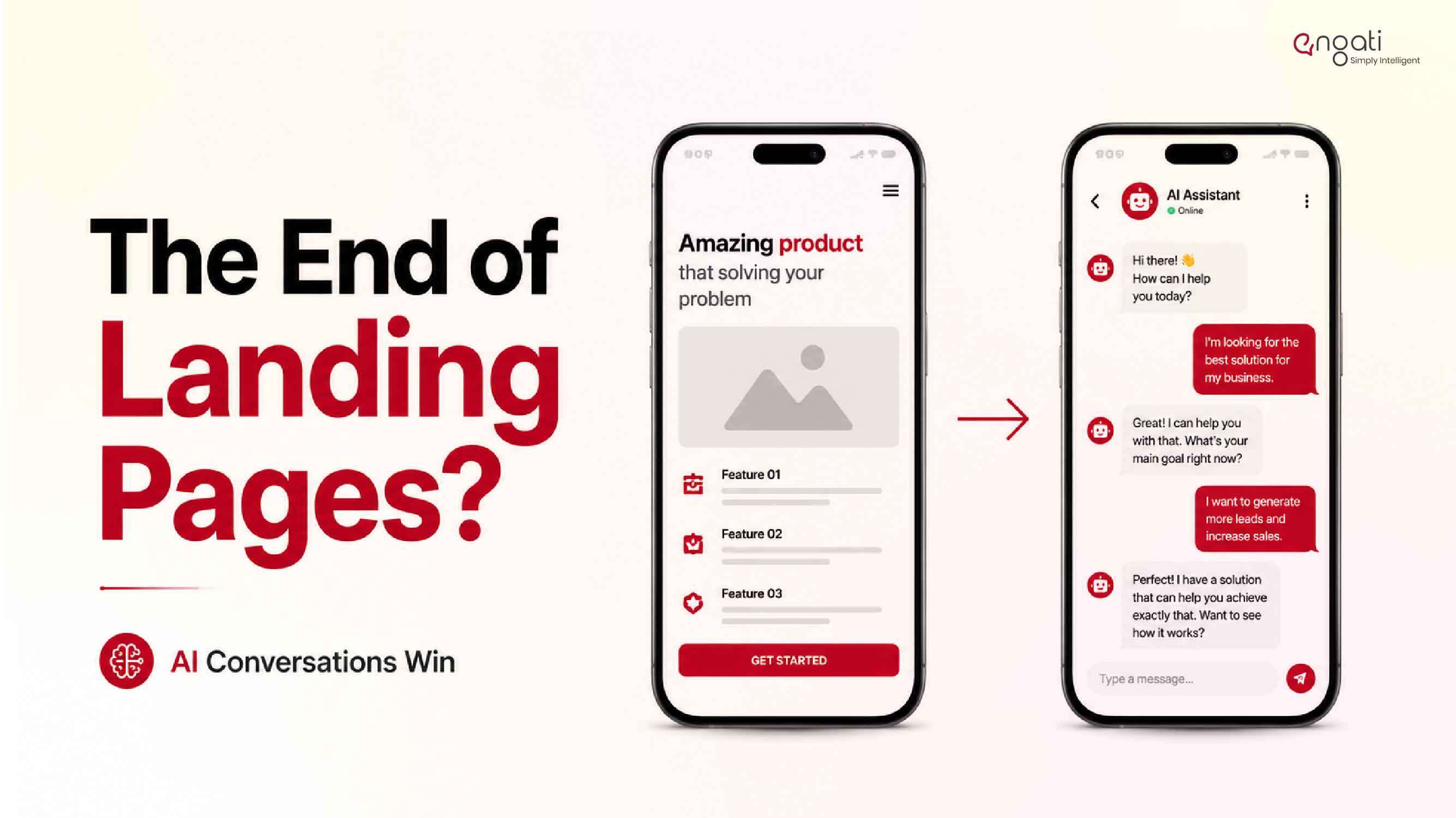
For almost two decades, digital marketing revolved around one core destination: the landing page.
Every campaign was designed to drive users somewhere. Ads pushed traffic toward websites, forms captured leads, and businesses optimized page layouts hoping to improve conversions one percentage point at a time.
The entire customer acquisition ecosystem was built around this flow.
But mobile behavior has changed dramatically, and the traditional funnel is starting to show its age.
Today’s users do not want to click through multiple pages, wait for websites to load, fill long forms, or wait hours for follow ups. They expect immediacy. They expect interactions to feel seamless. Most importantly, they expect businesses to respond while intent is still active.
That shift in customer behavior is exactly why conversational AI is becoming one of the biggest changes happening in digital engagement right now.
Because increasingly, users do not want to navigate businesses.
They want to talk to them.
The Traditional Mobile Funnel Is Losing Momentum
The classic mobile acquisition journey looks familiar:
Ad → Landing Page → Form → Follow Up → Conversion
The problem is that every additional step creates friction.
A user clicks on an ad but leaves because the page loads slowly. Someone abandons a form halfway through because it asks for too much information. Another user submits an inquiry but loses interest before the sales team responds.
Businesses spend heavily generating traffic only to lose momentum during the transition between intent and engagement.
And on mobile devices, this friction becomes even more noticeable because attention spans are shorter and switching behavior is faster.
This is why many businesses are starting to rethink whether landing pages should remain the center of customer acquisition at all.
Conversations Are Replacing Navigation
What makes conversational AI so powerful is that it removes the need for users to “go somewhere else” to continue the journey.
Instead of redirecting customers through disconnected pages and workflows, businesses can now engage users directly through conversational interfaces across messaging apps, voice assistants, chat systems, and RCS interactions.
A customer searching for a home loan does not necessarily want to browse through multiple product pages before speaking to someone. They want answers immediately:
- What are the interest rates?
- Am I eligible?
- How much can I borrow?
- What documents are needed?
Similarly, someone exploring a healthcare consultation wants appointment availability instantly. A student researching online courses wants counseling support immediately. A traveler looking for a hotel booking wants quick confirmations and flexible options without navigating complicated systems.
Traditional landing pages present information.
Conversations respond dynamically.
That difference changes the experience completely.
Why AI Driven Conversations Convert Differently
The biggest advantage conversational journeys have over traditional funnels is continuity.
Landing page experiences are often fragmented. Users move between ads, websites, forms, emails, and calls before reaching a decision. Every transition creates opportunities for drop offs.
Conversational experiences reduce that fragmentation by allowing the interaction to continue naturally in real time.
Using conversational AI platforms like Engati, businesses can engage users contextually from the very first interaction. Instead of forcing customers into static journeys, AI powered systems can guide users based on intent, behavior, and real time responses.
For example, a retail customer can:
- Browse products conversationally
- Ask questions instantly
- Receive recommendations
- Compare options
- Complete purchases inside chat
A healthcare provider can:
- Automate appointment scheduling
- Handle patient inquiries
- Enable rescheduling
- Send reminders conversationally
A real estate company can:
- Qualify buyers
- Showcase projects
- Schedule site visits
- Recover dropped leads automatically
The interaction becomes significantly more fluid because the system adapts to the customer rather than forcing the customer through predefined paths.
The Shift Is Bigger Than Chatbots
A lot of businesses still think conversational AI simply means adding a chatbot to a website.
But the shift happening right now is much larger.
Conversations are becoming the interface itself.
Customers are increasingly interacting with businesses through messaging platforms, voice interactions, AI assistants, conversational RCS journeys, and automated engagement systems rather than traditional browsing behavior alone.
This is especially important on mobile devices where users naturally prefer faster, simpler interactions.
The growth of RCS messaging is accelerating this trend further by enabling businesses to create rich conversational experiences directly inside the messaging inbox. Instead of redirecting users toward webpages, businesses can now continue engagement inside interactive conversations using quick replies, carousels, rich media, and AI driven workflows.
When powered by conversational AI from Engati, these journeys become highly scalable while still feeling personalized.
And importantly, they keep users engaged while intent is still active.
Why Businesses Are Moving Toward Conversational Funnels
The biggest reason conversational funnels are gaining momentum is simple: responsiveness has become a competitive advantage.
Customers now compare digital experiences across industries. They expect the same convenience from healthcare, banking, retail, hospitality, education, and real estate that they already experience from leading consumer platforms.
That means:
- Faster responses
- Personalized engagement
- Less friction
- Continuous support
- Real time interaction
Businesses that continue relying only on static landing pages and delayed follow ups risk losing customers before meaningful engagement even begins.
Conversational AI helps businesses reduce this gap significantly.
Instead of waiting for users to complete journeys manually, brands can proactively guide interactions, recover drop offs, automate support, and simplify conversion paths through continuous engagement.
Are Landing Pages Disappearing Completely?
Probably not.
Landing pages will still exist, especially for SEO, information depth, and brand storytelling. But their role is likely to evolve.
Instead of acting as the primary conversion destination, they may increasingly become supporting assets while conversational systems handle engagement, qualification, and action directly.
That is a major change in how digital marketing works.
For years, marketers focused on optimizing clicks and page performance. Increasingly, businesses may need to optimize conversational experiences instead.
How quickly can customers get answers?
How naturally can journeys continue?
How much friction exists before action happens?
How personalized does the interaction feel?
These are becoming more important conversion questions than traditional funnel metrics alone.
And that is why conversational AI is not simply changing customer support or automation.
It is changing how businesses acquire customers altogether.
With conversational AI solutions from Engati, businesses can build mobile first conversational ecosystems that replace fragmented journeys with continuous engagement experiences designed around how users actually behave today. To explore book a demo.