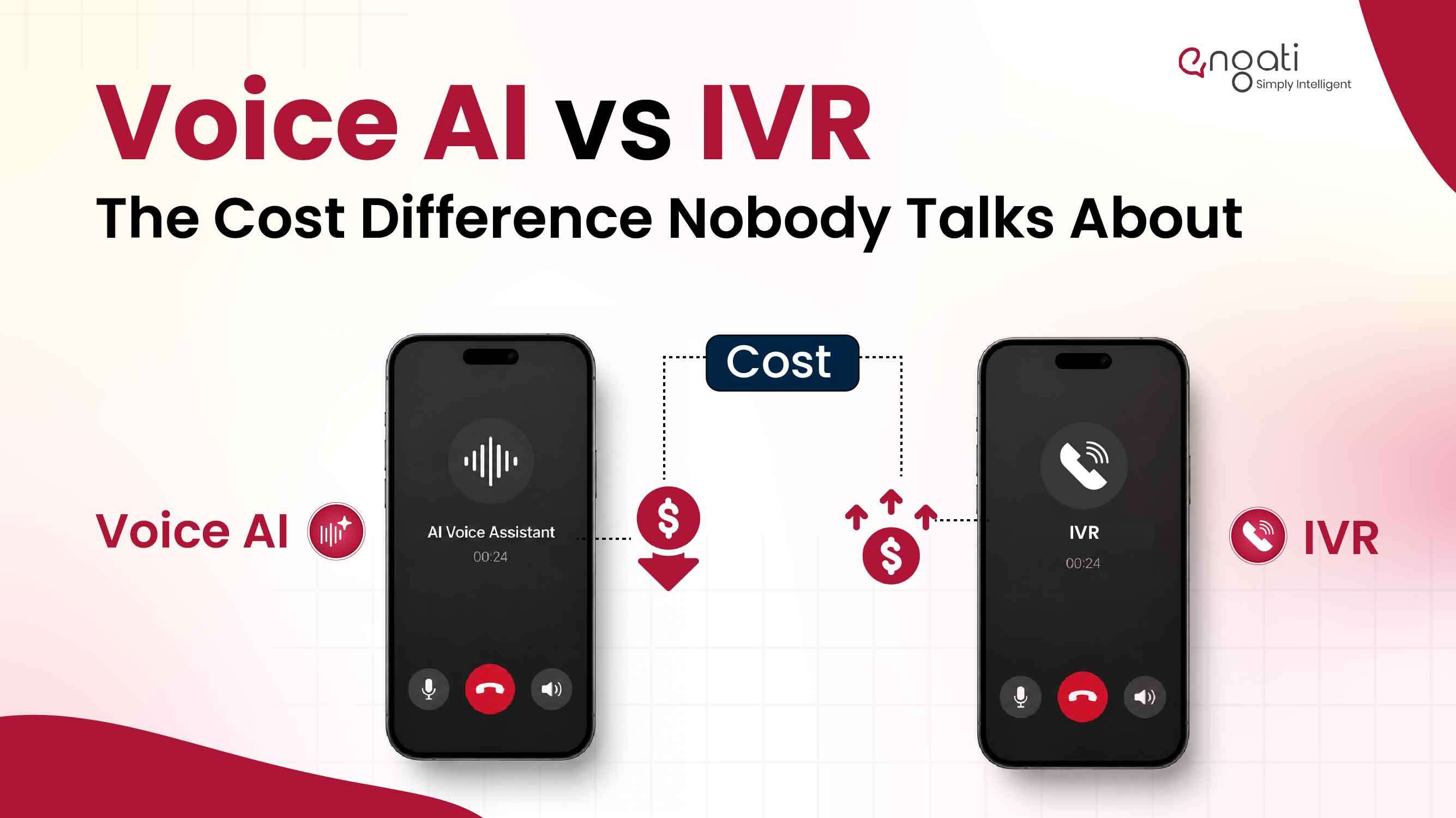
Voice AI vs IVR: The Cost Difference Nobody Talks About
For decades, Interactive Voice Response (IVR) systems have been the backbone of customer service operations. From banking and insurance to telecom and healthcare, IVRs have helped businesses route calls, reduce agent workload, and provide basic self-service capabilities.
But customer expectations have changed.
Today's customers are accustomed to conversational experiences. They interact with AI-powered assistants, messaging platforms, and digital services that understand intent rather than requiring them to navigate endless menus.
As a result, businesses evaluating customer engagement technologies are increasingly asking a new question: Should we continue investing in IVR, or is it time to move to Voice AI?
Most comparisons focus on features. Some focus on customer experience. Others compare implementation requirements. However, one of the most important factors often gets overlooked: the true cost. Not just the software cost. Not just the infrastructure cost.
But the total business cost of maintaining, operating, and scaling customer conversations.When organizations evaluate Voice AI and IVR through this broader lens, the financial picture looks very different.
Understanding the Difference Between IVR and Voice AI
Before comparing costs, it's important to understand how these technologies operate.
What Is IVR?
IVR systems guide callers through predefined menu structures.
Customers typically hear prompts such as:
"Press 1 for billing."
"Press 2 for technical support."
"Press 3 to speak with an agent."
The system relies on fixed rules and limited inputs to direct callers toward a resolution.
While effective for basic routing, IVRs often struggle when customers ask unexpected questions or require more complex assistance.
What Is Voice AI?
Voice AI replaces menu-driven interactions with natural conversations.
Instead of navigating options, customers can simply explain what they need.
For example:
"I'd like to check the status of my insurance claim."
or
"I need to reschedule my appointment."
The system understands intent, retrieves relevant information, and responds conversationally.
This fundamentally changes both the customer experience and the economics of customer service.
The Hidden Cost of Agent Transfers
One of the biggest expenses associated with IVR systems is not immediately visible.
It is the cost of escalation.
Traditional IVRs often fail to fully resolve customer requests. Their primary purpose is usually call routing rather than issue resolution.
As a result, a large percentage of calls eventually reach a live agent.
Every transfer creates costs related to:
- Agent salaries
- Call handling time
- Training
- Workforce management
- Operational overhead
Imagine a telecom provider receiving 50,000 monthly support calls.
If most of those calls require agent intervention after navigating an IVR, the organization is still paying for thousands of human interactions.
Voice AI changes this equation. Because it can understand intent and complete tasks directly, many customer requests can be resolved without human involvement. This increases containment rates and reduces operational costs significantly.
Average Handle Time: The Cost Multiplier
Every additional minute spent on a customer interaction has a measurable financial impact.
Traditional IVRs frequently increase Average Handle Time (AHT) because customers must:
- Navigate menus
- Repeat information
- Wait for transfers
- Explain their issue multiple times
The result is a longer path to resolution.
Consider a customer contacting a healthcare provider.
The customer may:
- Navigate an IVR menu
- Select appointment support
- Wait in a queue
- Repeat their request to an agent
The entire interaction could take several minutes.
With Voice AI, the conversation becomes more direct.
The customer simply says:
"I need to move my appointment to next Friday."
The system processes the request and provides available options. Fewer steps often translate into lower costs. When multiplied across thousands of monthly interactions, even small reductions in handling time can create significant operational savings.
Customer Frustration Has a Financial Cost
One of the most underestimated expenses in customer service is poor customer experience.
IVRs have earned a reputation for frustrating callers because they often force customers into rigid workflows.
Common complaints include:
- Endless menu options
- Long wait times
- Difficulty reaching an agent
- Repeating information
- Limited flexibility
While these frustrations may not appear on a financial statement, they affect:
- Customer satisfaction
- Retention rates
- Brand perception
- Customer lifetime value
A customer who abandons a call or leaves for a competitor represents a real business cost. Voice AI helps address this challenge by making interactions feel more conversational and intuitive. When customers reach resolutions faster, satisfaction improves and support costs often decline simultaneously.
The Maintenance Cost Nobody Budgets For
Many organizations assume that IVRs are inexpensive because they have existed for years.
However, maintaining complex IVR environments can become surprisingly expensive.
Every change often requires:
- Workflow updates
- Menu restructuring
- Testing
- IT involvement
- Vendor support
As products, services, and business processes evolve, these modifications accumulate.
Voice AI offers a different model.
Because conversations are built around intent rather than rigid pathways, updates can often be implemented more efficiently. Businesses can adapt customer interactions without redesigning entire menu trees. This flexibility becomes particularly valuable for organizations operating in fast-changing industries.
Scalability: The Cost Advantage of Voice AI
Customer demand rarely remains constant.
Retailers experience seasonal spikes.
Banks face increased activity during promotional periods.
Healthcare providers encounter fluctuating appointment volumes.
Scaling traditional support operations often requires:
- Hiring additional agents
- Expanding infrastructure
- Increasing training investments
These costs rise quickly.
Voice AI allows organizations to handle significantly higher conversation volumes without proportional increases in staffing costs. Whether handling hundreds or thousands of interactions, automation enables more predictable scaling. This is one of the key reasons enterprises are increasingly incorporating Voice AI into their customer engagement strategies.
Beyond Cost Savings: Revenue Opportunities
Most organizations initially evaluate Voice AI as a cost-reduction tool.
However, the larger opportunity often lies in revenue generation.
Unlike traditional IVRs, Voice AI can actively participate in customer journeys.
Examples include:
- Lead qualification
- Appointment scheduling
- Upselling services
- Customer onboarding
- Payment reminders
- Renewal conversations
A traditional IVR may route a sales inquiry.
A Voice AI system can qualify the lead before connecting them to a representative. This transforms automation from a support function into a revenue-driving asset. For many businesses, this additional value changes the ROI calculation entirely.
Voice AI and Omnichannel Customer Engagement
Another important consideration is integration.
Modern customer journeys rarely happen through a single channel.
Customers move between:
- Phone calls
- Websites
- Chatbots
- RCS messaging
- Live agents
Traditional IVRs often operate independently from these channels.
Voice AI can become part of a larger conversational AI ecosystem.
For example:
A customer begins with a Voice AI call.
The conversation continues through WhatsApp.
Follow-up information is delivered through RCS.
The entire interaction remains connected.
This continuity improves both customer experience and operational efficiency.
So Which Option Is More Cost Effective?
The answer depends on how organizations define cost.
If the comparison focuses solely on initial setup expenses, some IVR systems may appear less expensive.
However, when businesses evaluate:
- Agent workload
- Average Handle Time
- Escalation rates
- Customer satisfaction
- Maintenance requirements
- Scalability
- Revenue impact
Voice AI often delivers a significantly stronger long-term return.
The real cost difference is not found in software licensing fees.
It is found in how effectively each solution helps businesses resolve customer needs.
The Future of Customer Conversations
Customer expectations are evolving rapidly.
People no longer want to navigate complicated menus or repeat information multiple times before reaching a resolution.
They expect conversations.
Voice AI represents a shift from routing interactions to resolving them.
As AI automation continues to mature, organizations will increasingly evaluate customer engagement technologies based on outcomes rather than infrastructure.
Therefore, businesses that adapt early will be better positioned to reduce costs, improve customer experiences, and scale operations efficiently. The debate between Voice AI and IVR is no longer simply about technology. It is about business outcomes. While traditional IVR systems continue to serve a purpose in many organizations, their hidden costs often extend far beyond implementation and maintenance. Voice AI introduces a fundamentally different approach—one that prioritizes conversational engagement, faster resolutions, higher containment rates, and greater scalability. For organizations looking to modernize customer service and improve operational efficiency, the question is no longer whether automation should play a role. The question is whether menu-driven interactions can continue to meet modern customer expectations. Increasingly, the answer is no.
Ready to Move Beyond Traditional IVR?
Explore how Voice AI and conversational AI solutions can help your business reduce operational costs, improve customer satisfaction, and create seamless experiences across voice, WhatsApp, RCS, and other customer engagement channels. Book a Demo.
.jpg)